The Cocoa Pod That Has No Price
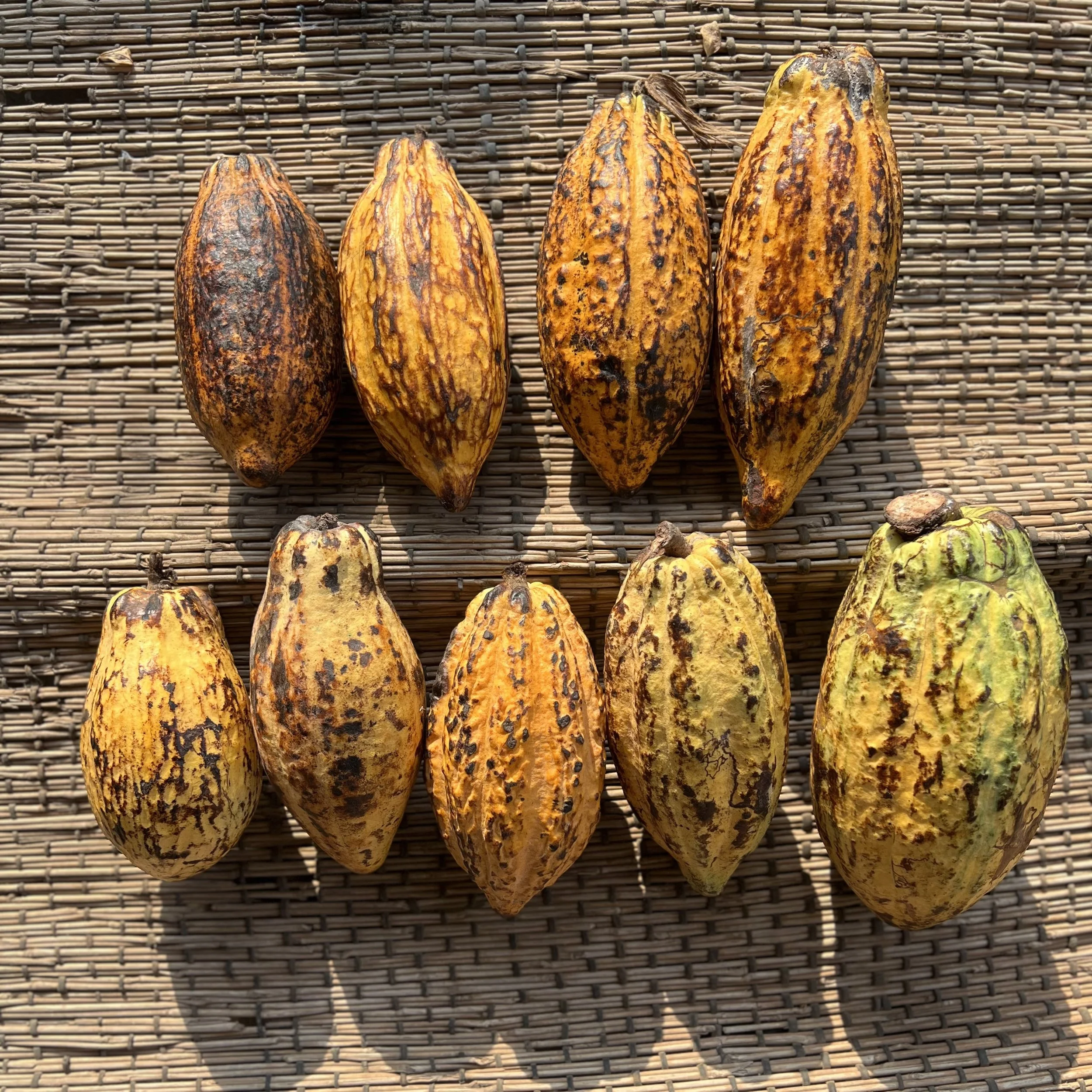
What a gifted pod from Tafo says about where value is made in chocolate, and who is paid for it.
The cocoa chain has a price for the bean and no price for the craft that grows it. Until that changes, the industry is spending down the labor it depends on.
I learned this in the simplest way possible. In Tafo, where the Cocoa Research Institute of Ghana is, I wanted to get cocoa pods from a farmer. I wanted to pay him. I do not want a farmer to grow something and not be paid for his labor. He could not give me a price.
The fruit without a price
In Ghana, we do not really have a price for cocoa fruit. It is meant to be processed for its beans, not sold as fruit. It is illegal for me to buy the beans from a farmer directly. And the pod is meant to have no other value. So the pods I carried away from Tafo were a gift.
That transaction tells you how the system defines value. The bean is the commodity. It is priced through a structure the farmer does not set, and the rest of the fruit falls outside the accounting entirely. The farmer's skill in growing it, his years of tending trees and his judgment about when a pod is ready never show up as line items. They are folded into a commodity price.
It is easy to name a price for something that is a commodity. It is much harder when something is called couture.
Where the value is made
I work with chocolate on a regular basis, and I still find it remarkable that somewhere along the line people decided to cut this pod open, ferment and dry the beans, grind them and add sugar and milk to arrive at milk chocolate. Every time I look at a pod on the tree, that transformation surprises me.
That transformation is where the value is. It is also where the value is captured, and very little of it travels back to the start.
Our installation, Commodity/Couture, starts from that gift. I took one of the pods to a brass caster in Kumasi, who cast it into the brass pod at the center of the work. So the room holds two kinds of craftsmanship: the farmer's and the artisan's. When something is handcrafted, we need to understand the value of that craftsmanship. The farmer's labor is craftsmanship too. We have simply agreed not to price it that way.
My position is not that people should stop eating chocolate. I want people to eat chocolate. I want my niece and nephews to eat real chocolate, and their children's children. That future depends on chocolate not being cheap. Cheap chocolate means the labor is not being valued, and when the labor is not valued, the work will stop. There should be a level of consumption that makes sense, so that we can keep the crop alive.
Why put it in a room
The problem is distance. All over the world, people are eating chocolate. Most have probably never seen a cocoa pod in real life. They do not know what it takes to get from the tree to the bar. Distance is not only a Western condition, either. Even within Ghana, where we live and breathe this story, not many of us visit cocoa farmers or have conversations with them about the process.
A report can be skimmed. An object in a room has to be walked around. That is why Commodity/Couture is a Special Project at 1-54 Contemporary African Art Fair in London, at Somerset House from 16 to 18 October. Cocoa is not indigenous to Ghana, but it shapes conversations across the continent. People in London who care about Africa should see what they consume and understand its impact there.
The installation also runs in both directions. A visitor's book will let people write back to the cocoa farmers after they have seen the work, and we are recording farmers' voices to share in the room. That is a design choice any institution can borrow. Most information in the cocoa chain flows one way, from buyer to farm. Very little flows back.
What this means for institutions
Cocoa buyers and chocolate brands: Treat farmer labor as craftsmanship in your cost model, not as an input absorbed into a commodity price. If you cannot say which line pays for the craft at origin, the gap sits somewhere in your supply chain.
Development finance: Programs that fund yield and certification without addressing who captures the value from the transformation leave the core imbalance in place. The question to fund is who stays in the industry, and why.
Cultural institutions: An art fair, museum or festival can close distance in ways a policy brief cannot. Build channels for audiences to speak back to producers, not only to look at their work.
Call Forward
If you are a sourcing lead, a funder or a cultural institution trying to put value back where it is made, that is the work I do. 👉🏾 Work with me.
Weekly letters on food, inheritance and power at origin: Substack