COMMODITY / COUTURE
An installation on Ghana's cocoa: handcrafted, undervalued, irreplaceable.
1-54 Contemporary African Art Fair · Somerset House, London
15–18 October 2026
A Special Project of the Midunu Institute
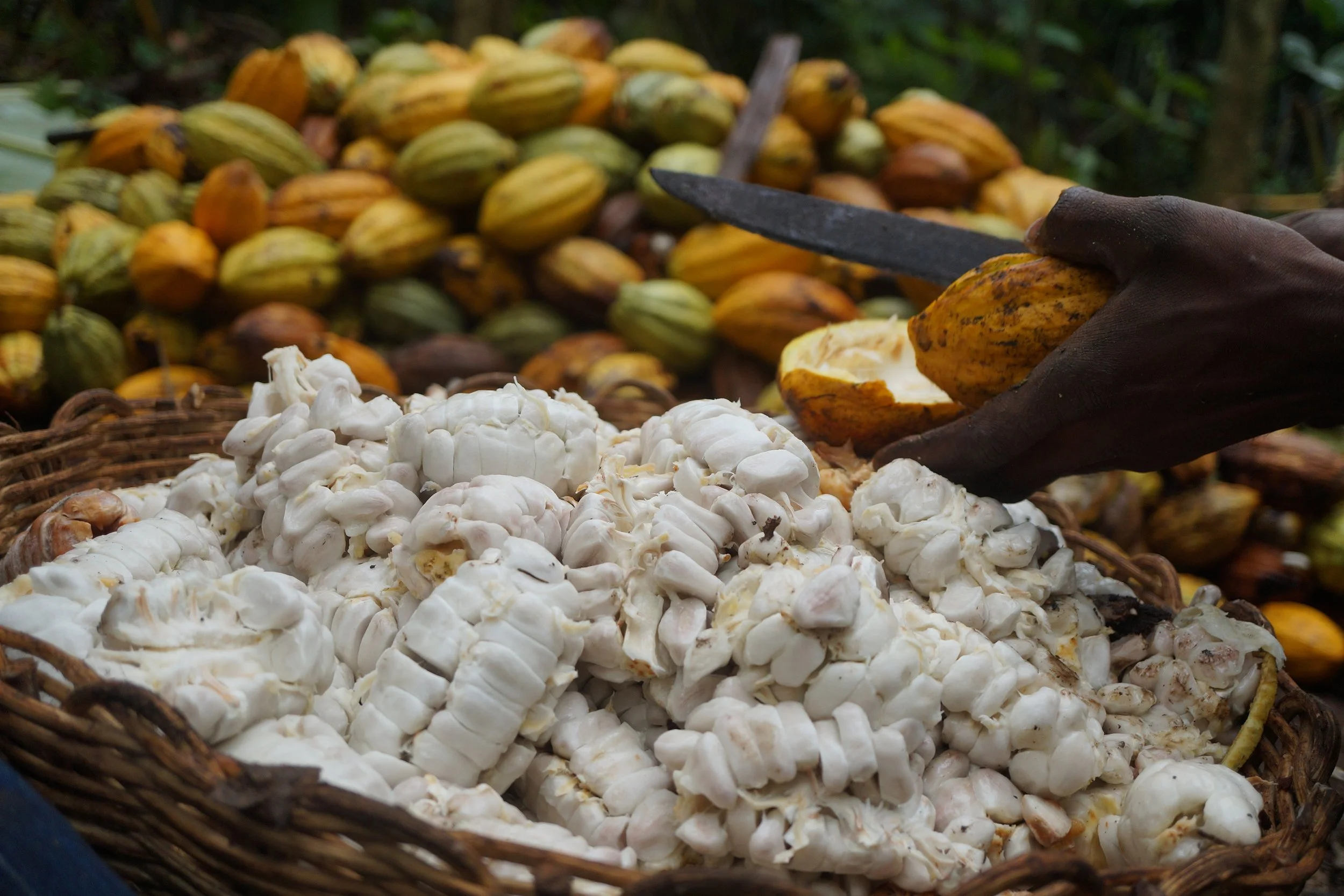
Of every £1 spent on chocolate, the farmer who grew the cocoa receives about 6p.
Why this work
Ghana grows some of the world's finest cocoa and keeps almost none of what it earns. The price of a bean is set on exchanges where no farmer has a seat. The largest margins sit in processing, branding and retail, all of which happen after the bean leaves the country. When farmgate prices rise, retail prices follow, and the farmer is never the beneficiary of that adjustment, though they are reliably its justification.
The trees are old, and the next generation is not guaranteed. Too few of their children are entering the profession. A multi-billion-dollar industry is roughly one generation from a supply base that no longer exists, and nobody has named it, because naming it would mean admitting the price structure is not just unfair but unsustainable on its own terms.
Commodity / Couture puts a cocoa pod cast in brass under a light, treats the fruit as the precious thing it is, and fills the room with the faces and voices of the people who grow it.
The Room
You cross a threshold of cocoa scent into a quiet room. At its center, on the tallest of five white plinths, stands a cocoa pod cast in brass by Ashanti artisans in Kumasi, made by the lost-wax method that has carried their craft for centuries. Beside it, the figure 6p. Around it, portraits of the farmers at each stage of their work: before harvest, harvest and pod-breaking, fermentation, drying. Their voices rise from cocoa sacks in the corners. At a table, a visitors’ book waits to carry your words back to them.
The Making
Everything in the room is made in Ghana. The voices are recorded on the farms, in the farmers' own languages, and composed into a soundscape for the space. The brass pods are cast in Kumasi by master artisans in an edition of fifteen, each resting on a carved cradle. The pods themselves come from Akyem Tafo, the home of cocoa in Ghana, given by the farmer who grew them, because there is no price for a cocoa pod in a system that only values the bean. The drinking chocolate is made by Selassie Atadika from cocoa sourced through cooperatives.
The installation practices its own argument: everyone who makes it is paid for what they know. This is the first public work of the Midunu Institute, which exists to keep African culinary knowledge living: cooked, taught, and carried forward. Commodity / Couture is where that work steps into the world.
The Founding Circle
A small circle of patrons is bringing this work into existence: the farmer honorariums, the voice recordings, the room at Somerset House, and the brass edition. We are halfway there. £3,500 closes it, and the circle closes on 25 September 2026. Two weeks. Every gift, at any level, puts the farmers' voices in the room.
Platinum · £2,500 — a brass cocoa pod from the edition of fifteen, with certificate and cradle, plus everything below
Gold · £1,000 — a preserved cocoa pod from the installation, and dispatches from the farms and the foundry, plus everything below
Silver · £500 — Midunu pralines, plus everything below
Bronze · £250 — Midunu drinking chocolate, the farmers' soundscape, your name on this page and with the Founding Circle as the work travels, and an invitation to the fair
Friend · £50 — a sachet of Midunu drinking chocolate and your name on this page
Another amount: write to me and I'll raise an invoice.
Founding Circle payments are received through Midunu Chocolates Limited (US), which holds the account, and are applied to the Midunu Institute's installation.
The Circle
With gratitude to the founding circle of Commodity / Couture:
Mosunmola Ogunbanjo · Steven Goldbach & Michelle Dunstan · Tarek Mouganie · Hannah Jones · Milana Mazaeva · Folabi Esan · Mae-Ling Lokko · Deborah Eleazar · Rosalind Nana Emela Kainyah · Josh Roberts · Duke K Essiam · Yvette N Ansah · Afua Dabanka ·
…and patrons who prefer to remain unnamed.
The Team
Selassie Atadika / Midunu Institute — Artist and Creative Director
Ato Annan / Co-Director, Foundation for Contemporary Art Ghana — Curatorial Advisor
Sena Affadu / Park Cultural — Production Manager and Video production
Selasie Gomado / Artemartis — Space design
Bright Ackwerh / Artist - Kumasi coordinator
Awanle Ayiboro / Artist - Limited Edition Artwork
About Selassie Atadika
Selassie Atadika is a Ghanaian-American chef, food systems strategist, and author. She is the founder of Midunu, which encompasses Accra-based dining, Midunu Chocolates, and the Midunu Institute. Before food, she spent her career in humanitarian and development work across Africa, which is where her understanding of West African food systems and farming communities began.
She is a recipient of the TIME Earth Award and a Global Table Fellow at Yale University. She spoke at the European Cocoa Association in 2018 on the value of Ghanaian cocoa and the human systems that produce it. Her first book, Gather and Feast, a literary nonfiction exploration of African food systems, memory and belonging, publishes in 2027.
Commodity / Couture is her first installation work, and the prototype for larger exhibitions on crops, inheritance and identity.
She lives in Accra.
Visit
Commodity / Couture opens at 1-54 Contemporary African Art Fair, Somerset House, Strand, London, 15–18 October 2026, with a VIP preview on Thursday 15 October.
Commodity / Couture — Selassie Atadika at 1-54 London 2026