The Room Worked. Then Everyone Asked What to Do Next.
What a cocoa installation at 1-54 London taught me about the gap between knowing and acting.
Awareness is no longer the bottleneck in cocoa. The next step is.
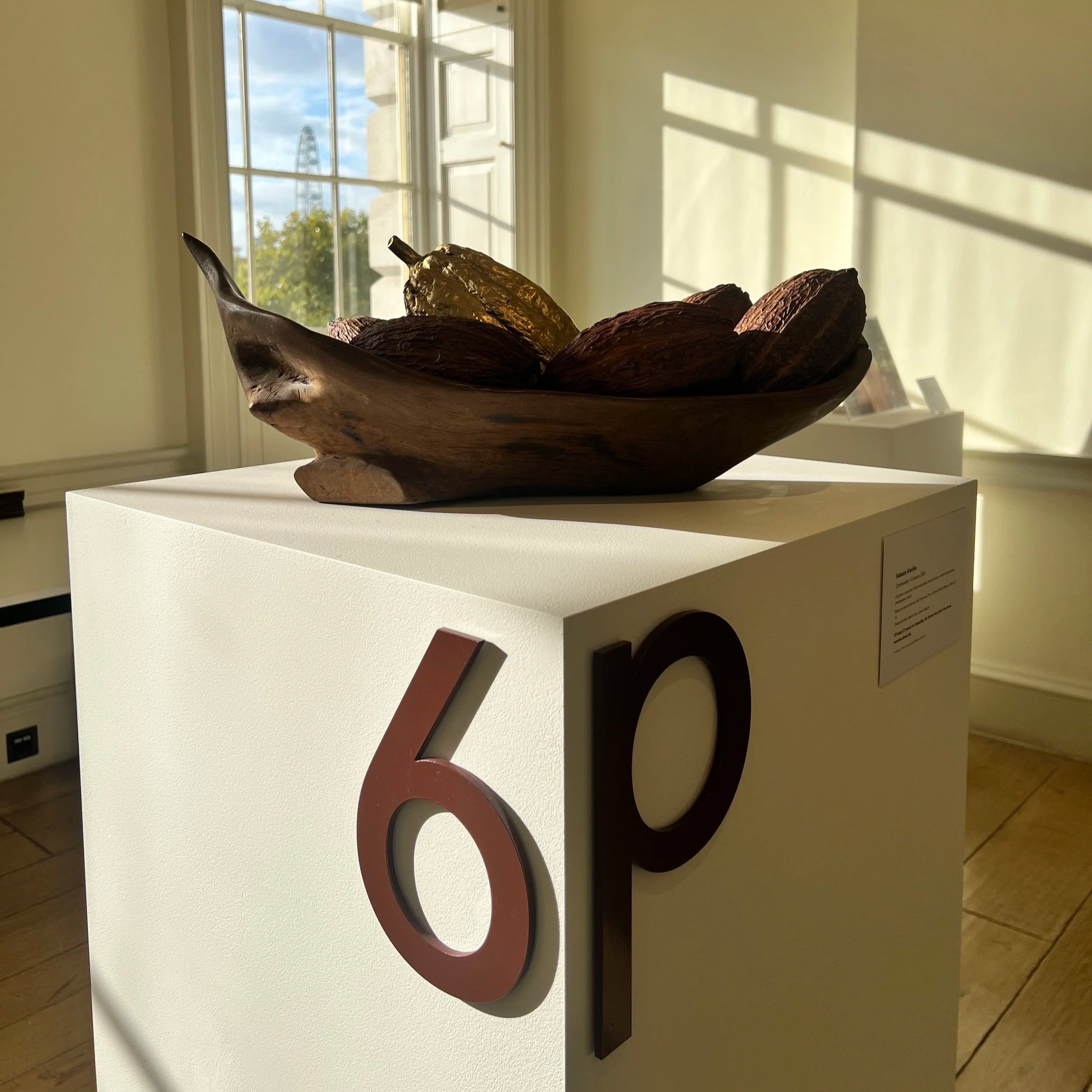
For four days in October, Commodity/Couture stood at 1-54 Contemporary African Art Fair at Somerset House in London. It was a quiet room. White walls held photographs of cocoa farmers from Adumadum, in Ghana’s Eastern Region, at four stages of the work, from pre-harvest to harvest to fermentation and drying. There were three cocoa sacks, two of beans and one of dried pods. The room carried the sound of a cocoa farm, chickens and crickets and pods cracking, along with the farmers’ own voices. At the center was a brass cocoa pod catching the light from a window.
The work did what it was built to do. People slowed down. And then, almost every time, they asked me the same thing.
What people said in the room
The first reaction was scent. “It smells like chocolate.” I heard that over and over. Many visitors had never seen a cocoa bean or a cocoa pod. Children did not know where their chocolate came from, so I would open a bean and explain what a 90% bar is compared with a milk chocolate bar.
The second reaction was a version of the same sentence: they knew it was not a great situation for the farmers, but they didn’t know how bad it was. By widely cited estimates, for every £1 spent on chocolate, about 6p goes to the farmer who grew the cocoa. That number stopped people.
The third was a question. “What do I do now?” People wanted to know whether change sits with government, with policy or with them as consumers. They asked which chocolate to buy and what to stay away from.
Two signals stood out for anyone who sells chocolate. Many visitors were openly against fake or lab-grown chocolate. And a lot of people said they were ready to eat less chocolate so they could have higher quality chocolate.
The hot chocolate I brought sold out in the fair’s pop-up shop, and people kept asking where they could buy more. Somerset House rules did not allow tasting in the room. So that demand came from people who had only smelled the cocoa and seen the work.
For chocolate, it is always about distribution. The interest is there. The work is getting a product people want into the markets where they are willing to pay for it.
Honor the labor, not the misery
One visitor told me the room was not enough. She wanted a harder image: a child holding the shirt of an exhausted farmer parent.
I understand the instinct. But people walk out of a room like that and do not want to engage. I chose to honor the labor of the cocoa farmers. These are people doing good work.
It was also a strategic choice. If you pay people correctly for the labor they are doing, you create a dynamic that moves toward the thing you want. You focus on what you want, not what you don’t want.
What I want is high quality chocolate made in Ghana. Over ten years of making Midunu chocolates, I have learned what that takes: traceability, provenance and farmers who are paid well. Without those, this inheritance does not continue.
The installation also tested how people read value. The brass pod was cast in Kumasi by Mr Emmanuel Fosu, a lost-wax master, from a pod grown on a family farm in Akyem Tafo. At the end of the fair, it sat in a bowl with dehydrated pods, cocoa without value beside cocoa with value. I expected interest in the brass pod alone. People wanted the whole set, and some only wanted the dried pods. The conversation between the two was what they wanted to take home.
Where the conversation goes next
London showed me what this work needs to become. It needs to help the people who walk into the room know what to do with that information next.
For consumers and art lovers, that means a clear path after the moment of recognition. For policy, it means deciding where this conversation belongs. Should it sit in a gallery, in a government space or back in Ghana, and if in Ghana, where?
Art can engage from a place of gentleness rather than harshness, and that opens doors a policy brief cannot. The next version of Commodity/Couture should be in Ghana, for Ghanaians to enter the conversation and understand, as a nation, what we are doing right and what we need to do better.
The industry is moving forward. If we want to stay in the game, things have to change, and quickly, for the farmers who stand to lose market share.
The visitors’ notes are going back to the farmers in Adumadum, with chocolate. Some of those farmers have never tasted it. You can meet them, hear them in Twi and write to them yourself at commoditycouture.com.
What this means for institutions
Cocoa buyers and chocolate brands: Your customers are asking what to buy. Give them traceability and provenance they can see, and price for quality over volume. The appetite to eat less and better is real.
Development finance: Fund the step after awareness. Programs that build traceability and fair pay at origin, and that bring the conversation into Ghanaian policy spaces, answer the question visitors could not answer for themselves.
Cultural institutions: An installation can close distance. Build in a way for audiences to act afterward, and a channel for their words to reach producers, as the visitor’s book did.
Call Forward
If you are a sourcing lead, a funder or a cultural institution trying to turn attention into action at origin, that is the work I do. 👉🏾 Work with me.
The brass pod is cast in an edition of fifteen. Collectors can declare interest here.
Weekly letters on food, inheritance and power at origin: Substack